Question:
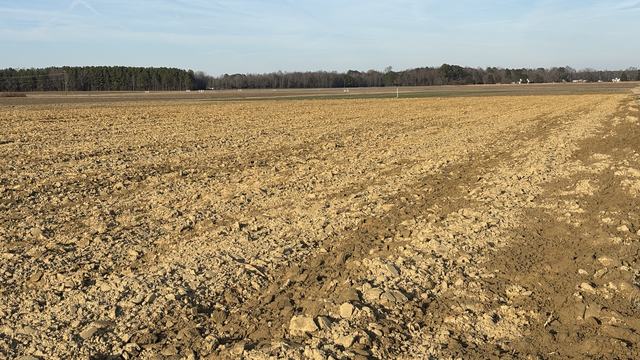
A farmer from Duplin County called me today regarding an errant application of swine lagoon sludge on one of his fields that was slated for peanut production in 2027. The applicator was supposed to be applying on the adjacent field and got in the wrong location. He treated a swath of 30' in width and approximately 2100 feet long. This is an area of approximately 1.45 acres of land.
Is there a typical zinc content in lagoon sludge? I realize the ultimate answer here lies in the current zinc content of the soil and the zinc content of the waste.
Do you feel this one application could be sufficient to push Zinc levels above the critical level? Is there any action that can be taken now to mitigate future trouble?
The sludge is on the surface now as applied. Should the land be plowed with a moldboard?
Any advice is appreciated. The grower is attempting to get a waste analysis.
Jordan:
The farmer sent me a copy of two reports on zinc in the sludge. They are 2.05 and 2.9 pounds per 1,000 gallons. I'll use 2.9 in the example below.
I couldn't find a volume per acre applied, but the earlier e-mail had a treated area of 1.45 acres. To get to a zinc index (in order to get to a recommendation,) we would need to know how much went out on 1.45 acres.
The conversion from pounds zinc per acre to zinc index is made by dividing pounds by 0.071.
If 1,000 gallons was spread over 1.45 acres, the amount of zinc per acre is about 2 pounds zinc per acre. This would likely end up with a zinc index of 28. From here, you can multiply 28 by a factor that describes how many more gallons went out. Let's say they put out 10,000 instead of 1,000. The zinc index would then be 280 above what is already in soil before the application. If they put out 100,000, the zinc index would be 2800.
I'm going to double check these.
Follow Up:
They applied 2500 GPA . So this would add to the zinc about 70 on the index. As long as the initial index was not too high it should be ok. That depends on past applications.
Kulesza:
Exactly. David’s calculation is spot on. It really depends on the initial soil concentration, but it doesn’t appear this will cause an issue. I would incorporate and take a soil sample to verify.
Follow Up:
The farmer is going to check the last soil test but I am thinking this will be ok.
Jordan:
Moldboard plow will not help. pH is the key mitigation factor.
Applications can be less than ideal in terms of uniformity. And soil pH could vary in places. Here's my relatively new recommendation on soil pH and zinc index for peanuts. It is still conservative but not as much as the hard 250-don't-plant-peanuts recommendation.
The following is in the production guide. We continue collecting data to see if we can increase the zinc index thresholds above the ones created below. I think we can, but every now and then a sample surprises me in a negative way. Early on in the sampling, I was surprised at how pH dependent the toxicity to zinc is for peanuts and how we can use that to plant peanuts in some really good fields.
Do not plant peanuts in fields if the zinc index is higher than 250 and soil pH is less than 6.0. If soil pH is between 6.0 and 6.5, peanut can be planted if the zinc index does not exceed 500. If soil pH exceeds 6.5, peanuts can be planted if the zinc index does not exceed 1,000. Note that animal waste, the primary source of zinc in agricultural fields, may not be distributed uniformly. Likewise, soil pH can vary across fields. In areas where soil pH is lower than the average for the field and the zinc index is higher than the average for the field, zinc toxicity can occur.