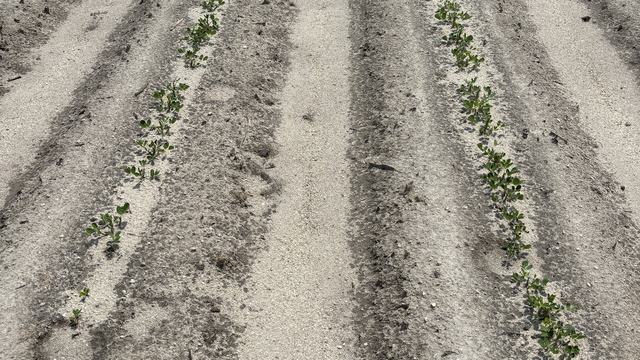
Green peanuts aside, the middle of April has tended in past years to mark when the window is cracked open for planting full season peanut. While we are still on this side of the season and before the last of the seed gets planted, we can hear the familiar refrain echo once more how saving a few pounds of seed from each lot opens the door if we want the option to later test seed germination. Last year this came in helpful, and whether dry-side conditions persist or otherwise switch during this year, it is nice to have the option should we want to use it. Along these lines, as much as possible, keeping seed in a cool dry place out of sunlight, heat, and extra humidity will help maintain quality as long as possible. 50 lb bags tends to be more forgiving compared to totes as well due to less buildup of stressful conditions in their centers.
While there does not appear to be much (or any) rain in the forecast for the coming week, at this point in time we should wait for dry fields to receive a rain before considering planting. Should a timely rain come our way, that presents an opportunity for dryland fields to be planted compared to irrigated fields to take advantage of the available soil moisture. Soil temp above 65F for at least 3 days is our rule of thumb before planting.
What seems like a few weeks ago, a question came up on liquid calcium compared to gypsum as an insurance move in a field that presently has high soil calcium levels. My recommendation is to save the money and not apply the liquid product. For most of our situations and equipment, this would go out through the sprayer over the top. Research from other programs has demonstrated this to not be effective based on the amount of elemental calcium and the lack of movement into the soil. Foliar absorption and translocation to pods is not something that happens. During our state meeting in January, Dr. Singh from UF did mention how liquid calcium products can be used with effective results if they go out through the pivot as fertigation. This is different from through the sprayer largely due to the amount of water that can be delivered which helps the product to move into the soil. If considering the timing of the ground sprayer, I would not apply a liquid calcium product through the sprayer in advance with the idea that multiple possible rainfall events would help to water the product in.
Hot and dry soils can stress and predispose young seedlings to Aspergillus crown rot, which can kill emerging seedlings and reduce stands during the first few weeks after planting. Aside from optimal planting conditions, the best prevention for crown rot is high quality seed that has been treated with effective seed treatment, including for example Rancona or Trebuset. Next in line would be a possible in-furrow addition. Azoxystrobin is probably going to be our least expensive in-furrow option, if we are looking to supplement. A 4 oz rate of Velum is also labeled in-furrow for Aspergillus.
Estimates from the NCSU Thrips predictor tool (https://products.climate.ncsu.edu/ag/cottontip/) suggest that thrips pressure for 2026 from April to early May may be greater than 2025 amounts. This tends to decline as we enter mid-May, which is also what the tool currently predicts.
Pre-plant incorporation of pendimethalin (Prowl) tends to support improved management compared to PRE. A question came up on if following incorporation with another pass for bedding would affect subsequent control. Running this by Dr. Marshall, he says that while we might could anticipate a slight increase in concentration on the beds and a slight decrease in concentration between the rows due to the soil movement during bedding, on the whole, the bedding should not be detrimental to the prowl.
A question came up comparing Georgia 16HO vs FloRun T61. As far as production potential goes, the two have consistently ranked in our upper grouping across multiple tests and years. Where these two tend to be a little more different is in T61 having greater TSW resistance and the potential for a slightly earlier maturity (a few days), generally improved early season vigor (16HO can be slow sometimes to fill out), and in some years T61 can have a slightly smaller seed size, but seed sizes for the two tend to overlap more than they do not. T61 also has a small amount of stem rot/white mold resistance, whereas 16HO does not. Both are susceptible to leaf spot.
Dan Anco
Extension Peanut Specialist and Associate Professor
Department of Plant and Environmental Sciences
Clemson University – Edisto Research and Education Center
64 Research Road
Blackville, SC 29817
630-207-4926 cell