Maturity
Cooler weather over the coming days will slow maturity development, but it is not cold enough to completely stop it. The formula we use for degree day accumulation uses a baseline of 56 F for the average temperature, above which we gain heat units. Lows in the 50s are offset as the days warm back up. The anticipated weather forecast has highs returning to the 80s next week, which will likewise help to add heat units for maturity development. As we prepare to enter October, field maturity ranges from being ready now to some fields potentially benefitting from a few weeks. Keeping an eye on the rain and digging/harvesting conditions are good to pair alongside pod maturities in deciding when to dig. Characteristically, our risk of frost becomes increased when we enter November.
Spider mites
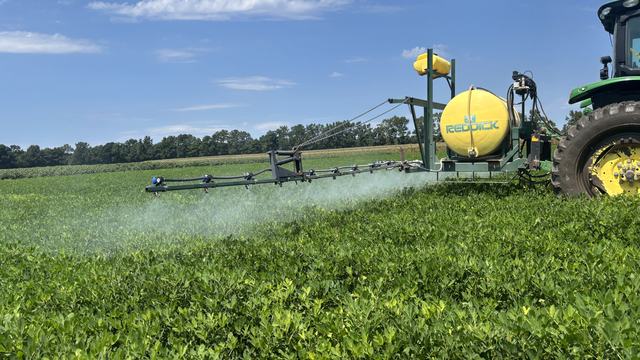
Twospotted spider mites have been observed in several fields in South Carolina this week and the week prior. Injurious spider mite infestations are associated with extended hot and dry conditions and are more frequently worse in dryland fields. Initial injury from spider mites can appear similar to drought stress with the appearance of a chlorotic yellowing of the canopy. Early stages of spider mite injury will show as a spotty checking over the surface of the leaf, and the mites themselves will often be visible when populations are large enough to be damaging. A consultant has noted how mites can also be seen on the ATV after riding through a field, which may be able to be seen before damage. As feeding injury increases, leaflets can develop a scorched appearance near their edges. This can look like a bronze cast over patches of a field. As feeding injury continues, defoliation of the canopy follows, which weakens plants and reduces pod retention. The mites are small (~0.5 mm, like a small breadcrumb) and have a yellowy color. Under magnification, two spots may be seen near the sides of their backs, hence their name. Silk webbing between leaflets can be seen under increased populations as well. Under suboptimal conditions, the life cycle from egg to larva through two nymph stages to adult can take < 20 days; under warmer temperatures (81 F) this is reduced ~two-thirds to 7 days. Under warm conditions, spider mites can reproduce rapidly, with females having been reported as laying up to 19 eggs per day. Similar to certain other pests, spider mites often tend to first become established along field borders, paths, or dirt roads. Dispersal is increased during corn senescence and harvest. Mowing borders, including weedy borders, during the growing season has been associated with increased risk of mites moving into neighboring peanut fields. As we also aim to reduce weed populations going to seed, where feasible it is helpful to establish weed-free field borders early in the season, maintaining these as the season goes on. Natural predatory insects can help to limit development of spider mite populations; along these lines, (frequent) application of broad spectrum insecticides such as pyrethroids, particularly during periods of risk of hot/dry weather, increases the risk of flaring spider mites. This is a helpful reminder of the value of judicious consideration regarding broad spectrum insecticides for pests such as velvetbean caterpillar. The cooler weather over the coming days will help to slow development of spider mite populations and will complement management practices where appropriate. Cooler weather with rain or irrigation also helps to promote growth of a natural fungus that helps to limit spider mite populations.If a field is within 2 weeks of harvest maturity, a miticide treatment would not be recommended. Depending on the field and where production potential is in good standing, if 3 or more weeks are needed for rounding out development of maturity, a miticide application may be considered. Current management options, in addition to irrigation where available, include Vertento (0.7 fl oz/A), Portal (1 to 2 pints/A), or Microthiol Disperss (5 lb/A up to 8 lb/A). To improve coverage, applications for mite control should be applied at 20 GPA.
Dan Anco
Extension Peanut Specialist and Professor
Department of Plant and Environmental Sciences
Clemson University – Edisto Research and Education Center
64 Research Road
Blackville, SC 29817
630-207-4926 cell
The following document from Dr. Anco includes images of spider mite injury on peanuts.