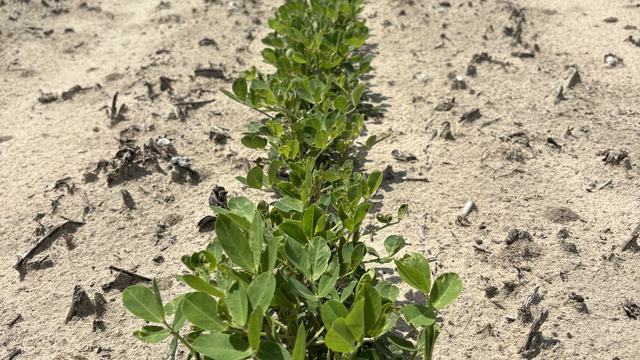
Wilted Limbs:
Drake Perrow, crop consultant, Cameron, SC, noticed drooping peanut limbs across a range of varieties. The unusual symptoms were observable over a wide area of fields and did not appear to be consistent with drift or otherwise application-related causes. We don't see it every year, and it is somewhat counterintuitive, but excessive water can also cause wilting that is not dissimilar to that caused by drought. I think this is what is happening here as well. We saw similar things in previous years, including 2020. Included are pictures with wilting from both too much and not enough water.
J-Rooting:
It is not uncommon to see some J-rooting (picture included attached) in a given year, and this is more common following adverse growing conditions, which includes cool conditions or waterlogged soils. In a 3-year study published by Dr. Prostko's team with UGA, flumioxazon (valor) and s-metolachlor (dual) did not result in greater j-rooting compared to nontreated controls
Rotation Intervals:
Strongarm and Cadre are both group 2 herbicides. Crop rotation restrictions from their labels overlap but also differ in places. In SC, the restriction for cotton is 18 months after Cadre application and generally 10 months following Strongarm application. The Strongarm label includes notes for potential injury where spray booms overlap, areas where increased spray deposition occurred such as due to slower sprayer movement near an edge, or in combination with early season stress from unfavorable growing conditions. The Cadre label further recommends that Cadre not be applied in a field that previously received Strongarm (or Pursuit) during that season.
Early AMS?:
I am not aware of data supporting the economic benefit of the application of a small amount, for example ~100 lb, of AMS to peanut during the early stages of growth. My personal opinion is that if it were my field, I would save the money and not apply the AMS.
Fields planted near April 20 are near 45 days old today and receiving first fungicide applications. For fields where soil tests indicate boron levels less than 0.4 lb/A, 0.3 to 0.5 lb boron/acre can be applied with an early season herbicide application or in the first fungicide application.
Dan Anco
Extension Peanut Specialist and Associate Professor
Department of Plant and Environmental Sciences
Clemson University – Edisto Research and Education Center
64 Research Road
Blackville, SC 29817
630-207-4926 cell