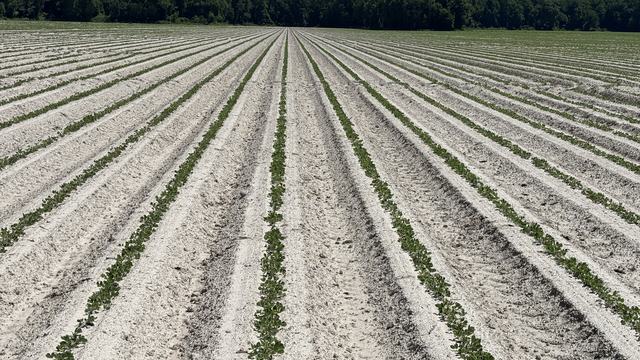
Volunteer Peanut
Volunteer peanut during a rotation crop can act as a host or reservoir for infection by foliar and soil diseases, reducing the effectiveness of a rotation in decreasing disease. Volunteer peanut that are near to a field planted this year to peanut are a risk factor for increasing disease pressure for late leaf spot, which can prompt more robust fungicide programs, particularly if applications become delayed. Scouting suspected areas is the best way to determine their presence or absence. Herbicide options for managing volunteers in a cotton or corn crop are listed on page 11 of the production guide.
Chlorotic Canopy
Several different fields are showing chlorotic yellowing of the leaves and later in the growing season. Depending on the details, this can sometimes show up more in Virginia cultivars compared to runners. Several things can be involved. Poor growing conditions from being too cloudy or wet for too long, tomato spotted wilt symptoms, root damage from disease, pests or certain nematodes, hopperburn caused by potato leaf hopper (v-shaped yellowing at leaflet tips), manganese deficiency (interveinal chlorosis on new growth), nitrogen deficiency (shows up earlier on old leaves), intermediate zinc toxicity (blotchy yellowing), leaf scorch (yellow symptom on the leaf typically with a lesion in it), some herbicide injuries including Cadre yellow flash on new growth, in addition to other sources. Options for response depend on what is causing the symptom. Supplemental AMS application or liquid N between the rows is not cheap but is the primary course of action where inoculant has failed. To check nodules for active nitrogen fixation, they should appear red or pink when cut open. Gray or brown indicates they are inactive or dead. Tan/beige nodules can be inactive due to molybdenum deficiency, which is rare but can occur at low soil pH (~5.5). Manganese deficiency can be anticipated based on soil tests and treated through addition of Mn during subsequent fungicide applications.
Pasture Herbicide Injury
Included in the attached pictures are injury symptoms from Grazon P+D (picloram + 2,4-D) and Remedy (triclopyr) drift on peanut. These two herbicides are used in hay/pasture fields and typically require 2 to 3 years of rotation before peanut should be planted in fields where they have been applied.
Dan Anco
Extension Peanut Specialist and Associate Professor
Department of Plant and Environmental Sciences
Clemson University – Edisto Research and Education Center
64 Research Road
Blackville, SC 29817
630-207-4926 cell