Statewide peanut acres are moving past 5% planted as we come out of April and enter May. As is standard, rainfall continues to vary across the state, with some spots having received 4"+ last Thursday, to a few tenths, to none received. Soil moisture is starting to become limited in areas. We may get some rain through the weekend, but if not, drier dryland fields may need to hold off until conditions improve.
Planting Depth
A planting depth of about 2-3" is a good overall target. Planting deeper (to 4") can be okay with good germ/vigor seed if the following growing conditions continue to be favorable, but the risk of planting too deep becomes more important under lower quality seed and slower growing conditions where the seedling can effectively run out of steam before reaching the surface. J-rooting can increase when a cold front moves in and the upper soil temperature cools down, but at least for the near term this does not look like it is an immediate concern from the forecast. So far all indications point to seed quality being good this year.
On the other end of things, planting too shallow (less than 1.5") can increase risk of injury from pre-emergent Valor (flumioxazin) on developing seedlings, and shallow depths also potentially put liquid inoculant at an increased risk of failure when soil conditions are dry and/or hot. Granular/peat formulations of inoculant tend to handle drier soil conditions better than a liquid inoculant, but seed still need moisture to grow. Dry conditions at planting can also limit granular insecticide absorption.
Insecticide Options
The attached pictures include volunteers with thrips injury varying from chlorotic spotting to larger yellow and wrinkled leaflets, to necrotic terminals. With these volunteers all having no insecticide treatment, there is not the visual comparison to see the stunted growth heavy thrips feeding can cause, but stunting can be quite apparent when pressure is high. Twin row planting increases the number of rows in the field, which acts to more or less spread out thrips feeding, which in turn reduces the overall intensity. Due to this, there is an inherent increase in flexibility of insecticide choice when planting twin rows. The attached slides are from a test where we compared different insecticides under a single row 38" pattern. While more differences were seen for thrips injury control and TSW management, yield differences did not separate out in that test.
Volunteers
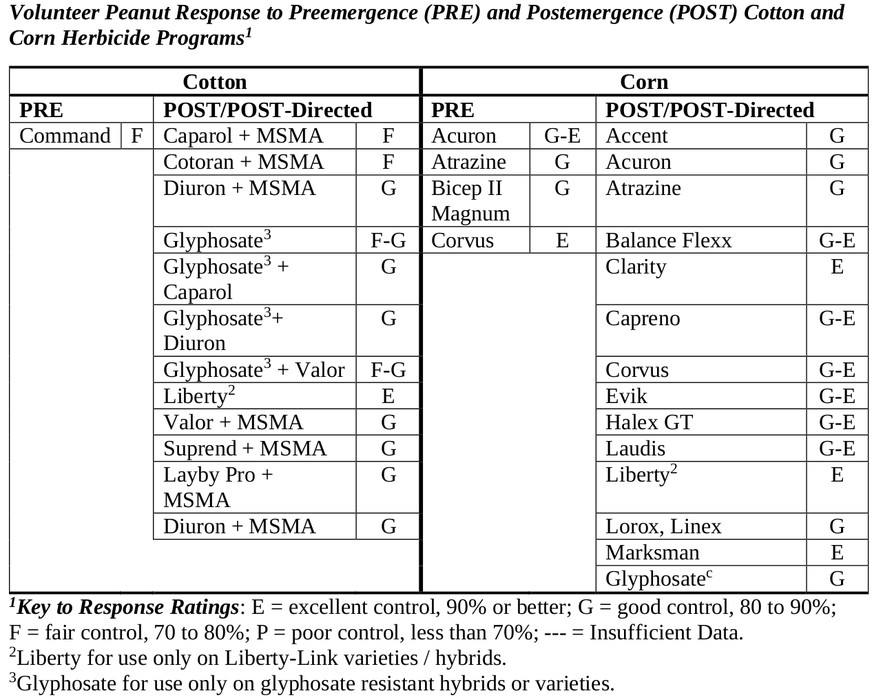
Peanut volunteers can emerge over a period of time and should be controlled to gain the most benefit out of rotations. A table of herbicide efficacy for cotton and corn crops from Dr. Marshall from the production guide is attached for reference. If volunteer peanut are near to where peanut are planted this year (as in a split-field rotation) and are not controlled, this can increase leaf spot pressure even for this year's crop.