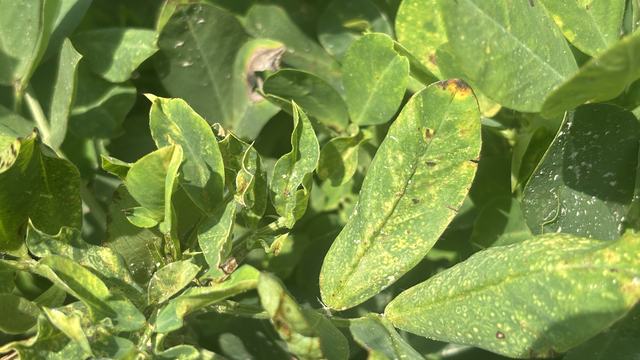
Question:
Sometime when you get a chance, and you may already have a program start to finish, but how do we deal with TSWV? I need the best program you got with planting dates, variety, in-furrow insecticides, etc. I have some guys that have been hit hard for 2 years. I would say we are close to what we had when we grew VA 98R years ago. It’s bad.
Jordan:
The short answer, which I think is still true, is the following. This is the approach that reduces risk. It matches UGA programs and is based on our work around 2002 with Perry and VA 98R.
1) Plant in mid May. April and early May are high risk.
2) Establish 5 plants per foot of row in single rows and 6 plants in twin rows (3 plants for each of the two twins.) Twins are slightly better than singles, but high seeding rates in single rows will make a big difference.
3) Our best genetics right now is Bailey II. We need to learn more about NC 20, NC 21, and NC 25. And need to look in more detail at Emery.
4) Use Phorate/Thimet in the seed furrow and follow up with Hemi plus surfactant within 3 weeks after peanuts emerge. We need to avoid imidacloprid (it has become relatively weak on thrips due to resistance and it can make TSWV worse, independent of thrips control.) I just think farmers need to put boxes back on their planters.
5) Plant in reduced till if your soil series allows it (we have a risk tool for tillage that can help people make that decision.)
If a farmer does all of these things, they have put in a full TSWV management program. It makes a significant difference compared to what we have been doing to date by many growers.
But organisms change and we need to consider that as well.
Each farmer may struggle to put all of these in place. But if I am having a lot of TSWV, I would need to focus on that. Many of our other pests can be addressed with pesticides after the crop is up. We have a chance to “rescue” the crop. That is not the case with TSWV. When you drive away from the field after you plant, your TSWV management is done. Much of TSWV management is about avoiding the peak infestation of thrips when peanuts are first coming up. But other things contribute to management.
Take a look at our production guide in the insect chapter. The risk tools Dominic has for TSWV and to a degree southern corn rootworm are likely underutilized by the peanut community. We’ve been on autopilot for a while, but now we need to scrutinize our practices and likely change some things we are doing.
Tillage has a positive effect but it is marginal. That’s a big shift for a marginal benefit. But it is real.
Genetics are important but Bailey II is as good as we have right now. And it is so much better than the varieties that used to get hammered - Perry, CHAMPS, VA 98R, etc.
Plant population is very important. We can all increase our seeding rates. In some ways, this is the easiest one to do. Adds expense, but in a reasonable way. The more plants you have, the greater the compensation you have by the healthy plants. There may be some visuals thrips observe when spotty stands are present that make that field or area of a field more attractive. But, I think it is mostly about thrips finding something to feed on. If you have fewer plants in a field, each plant is going to have more thrips and virus. It’s a numbers game.
In-furrow insecticide is very important. But outside of the value of Phorate, which is well documented, there is not a major difference among insecticides, but there are some differences. I do think we need to stop using imidacloprid in areas where the virus is active. This insecticide is marginal on thrips, the vector for the virus, and researchers have documented more virus when imidacloprid is used.
I get that when April is warm and fields are ready, growers want to get going. But early May and April plantings are risky for several reasons. With respect to TSWV, the peanuts planted early just sit there and the thrips keep coming and feeding and vectoring virus. There are just more thrips. Emergence can be less uniform and in some instances stands are lower in some areas of fields with early plantings. We need to plant later to minimize TSWV risk.
In the early 2000s, when TSWV hit us hard, we moved to NC V-11 and Gregory. It took a few years for this transition, but in the interim growers planted more of their peanuts in mid May, increased seeding rates, and used Thimet. Some growers transitioned to reduced tillage, but we found that you had to be careful on this when it comes to soil characteristics and digging.
Fast forward to now, imidacloprid has been popular because it is cheap. It mixes well with inoculant. The climate has more variation than it used to and when it tends to feel warmer in April, it makes us feel like we can plant earlier. Twenty-five years ago we had more farmers with less acreage, so pushing back to mid May was a reasonable way to go logistically. Farmers now have thousands of acres to plant in a short window and a lot of them can be peanuts. It’s hard to get it all done by June 1. The resilience of peanuts makes them a good crop to plant early. The seed has lots of energy, fungicide seed treatments are effective in protecting seed and seedlings coming up for an extended period of time, and you can plant deep to moisture. You feel pretty good about getting stands eventually. Move onto something else You need to do on your list. And our seed quality is good due to technology and a committed seed industry. Peanuts are tough. Go ahead and get them out there in April and early May. They will be okay.
BUT all of this creates greater risk for TSWV. Tom Isleib’s releases including Bailey and Bailey II gave us a tremendous buffer genetically against TSWV and some of our other diseases. But a single approach to any pest will eventually experience a decline. We have to be more comprehensive with our management, and TSWV is once again reminding us this of this fact in agriculture.
I know the logistical challenges faced by today’s farmers. All of the reasons I listed about planting date will likely work if you do not have TSWV.